SEO · 8 min read
How to Rank Higher on Google: 7 Factors That Actually Move Rankings
Most SEO advice lists dozens of factors. In practice, seven account for the majority of ranking movement. Here is what each one is, why it matters, and the specific action that moves it.
By Hivex Digital ·
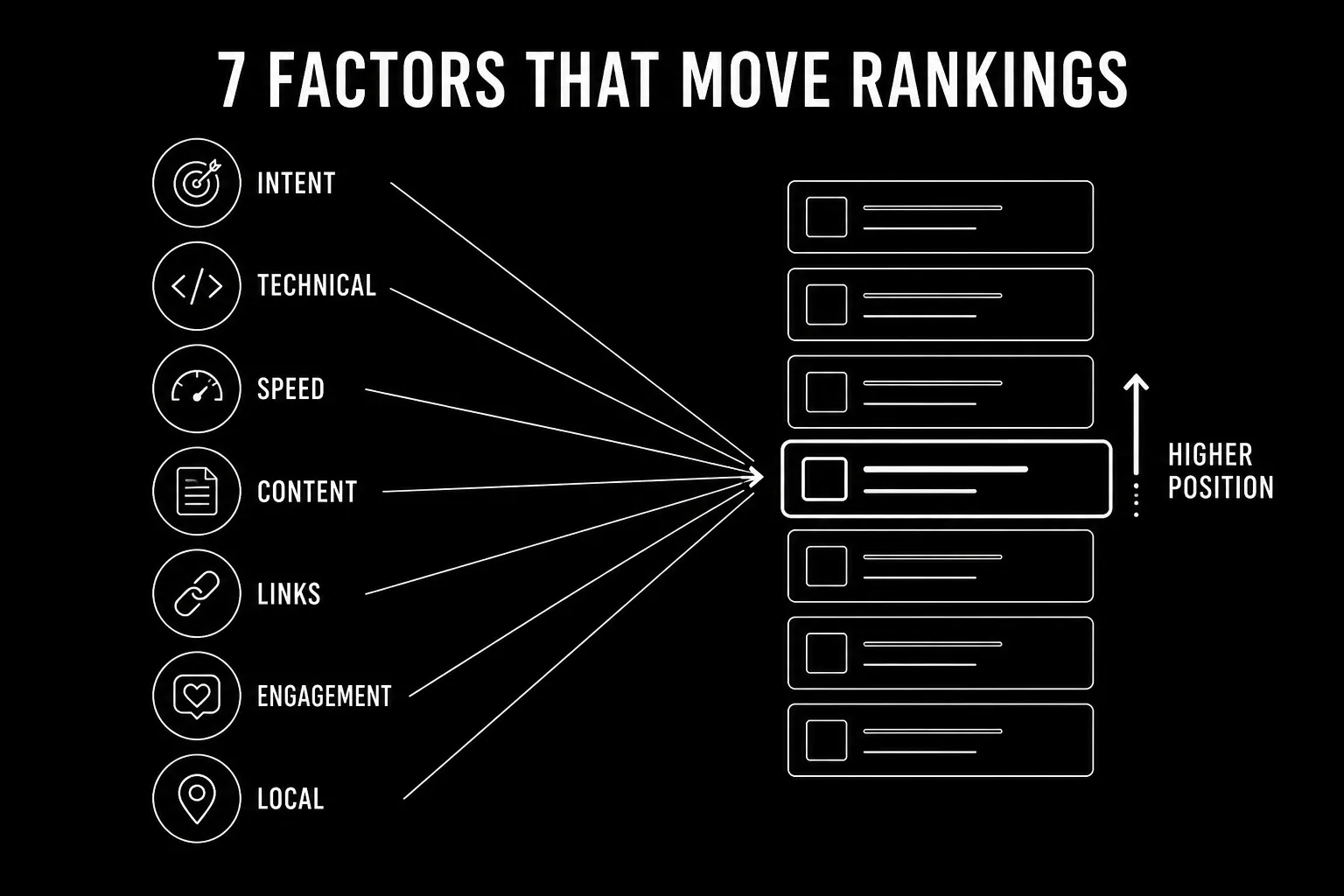
Google uses hundreds of signals to rank pages, but in practice, seven factors account for the majority of ranking movement for most sites. Understanding all two hundred is less useful than executing the seven well. Here is what each one is, why it matters, and the specific action that moves it.
1. Does your page match the search intent?
Relevance to search intent is the foundation of ranking. Google's job is to return the page that best answers the query, and it has become very good at understanding what a searcher actually wants — not just the words they typed. A page targeting best CRM software needs to compare and recommend tools, not just define what a CRM is. Matching the format, depth, and angle of the top-ranking pages for your target keyword is the first thing to get right.
2. Is your page technically crawlable and indexed?
A page that Google cannot crawl or has not indexed cannot rank, regardless of its quality. Check Google Search Console for coverage errors, blocked resources in robots.txt, and noindex tags applied by mistake. Pages that are slow to be discovered or frequently recrawled at low priority are often suffering from crawl budget issues caused by duplicate content, redirect chains, or a bloated sitemap. Fix the technical foundation before optimizing anything else.
3. How fast does your page load?
Core Web Vitals are confirmed ranking signals. Largest Contentful Paint measures how fast the main content loads. Interaction to Next Paint measures responsiveness. Cumulative Layout Shift measures visual stability. A page that fails these benchmarks ranks lower than an equivalent page that passes them, and it also converts less of the traffic it does receive. Speed is both a ranking factor and a revenue factor.
- LCP under 2.5 seconds: optimize images, reduce server response time, eliminate render-blocking resources.
- INP under 200ms: minimize JavaScript execution on the main thread.
- CLS under 0.1: set explicit dimensions on images and embeds so layout does not shift as the page loads.
4. Does your content answer the question thoroughly?
Thin content — a page that touches a topic without covering it — ranks poorly because it does not satisfy the searcher. Thorough content answers the primary question, addresses the follow-up questions a reader naturally has, and does so with specific, accurate information rather than vague generalities. The goal is not word count; it is completeness. A 600-word page that fully answers a narrow question outranks a 3,000-word page that circles the topic without landing.
5. Do authoritative sites link to your page?
Links from other sites are still one of the strongest ranking signals, because they represent a vote of confidence from a third party. A link from a relevant, authoritative site carries far more weight than dozens of links from low-quality directories. The most reliable way to earn links is to publish content that is genuinely useful and specific enough that other sites want to reference it. Tactics that manufacture links at scale tend to produce short-term gains and long-term penalties.
6. How do users behave when they land on your page?
Google watches what happens after a click. If users land on your page and immediately return to the search results, that is a signal the page did not satisfy the query. If they stay, scroll, and engage, that is a signal it did. These engagement signals are not a direct ranking input in the way links are, but they influence how Google adjusts rankings over time. A page that consistently disappoints searchers will drift down; one that consistently satisfies them will hold or rise.
7. For local searches: is your Google Business Profile optimized?
For any search with local intent — near me, city name, or a service category in a specific area — Google Business Profile signals dominate the map pack results. Primary category, completeness of service listings, review quantity and recency, and active posting all feed the local algorithm. A well-optimized profile can outrank a competitor with a stronger website for local queries, because the map pack runs on a partially separate ranking system from organic results.
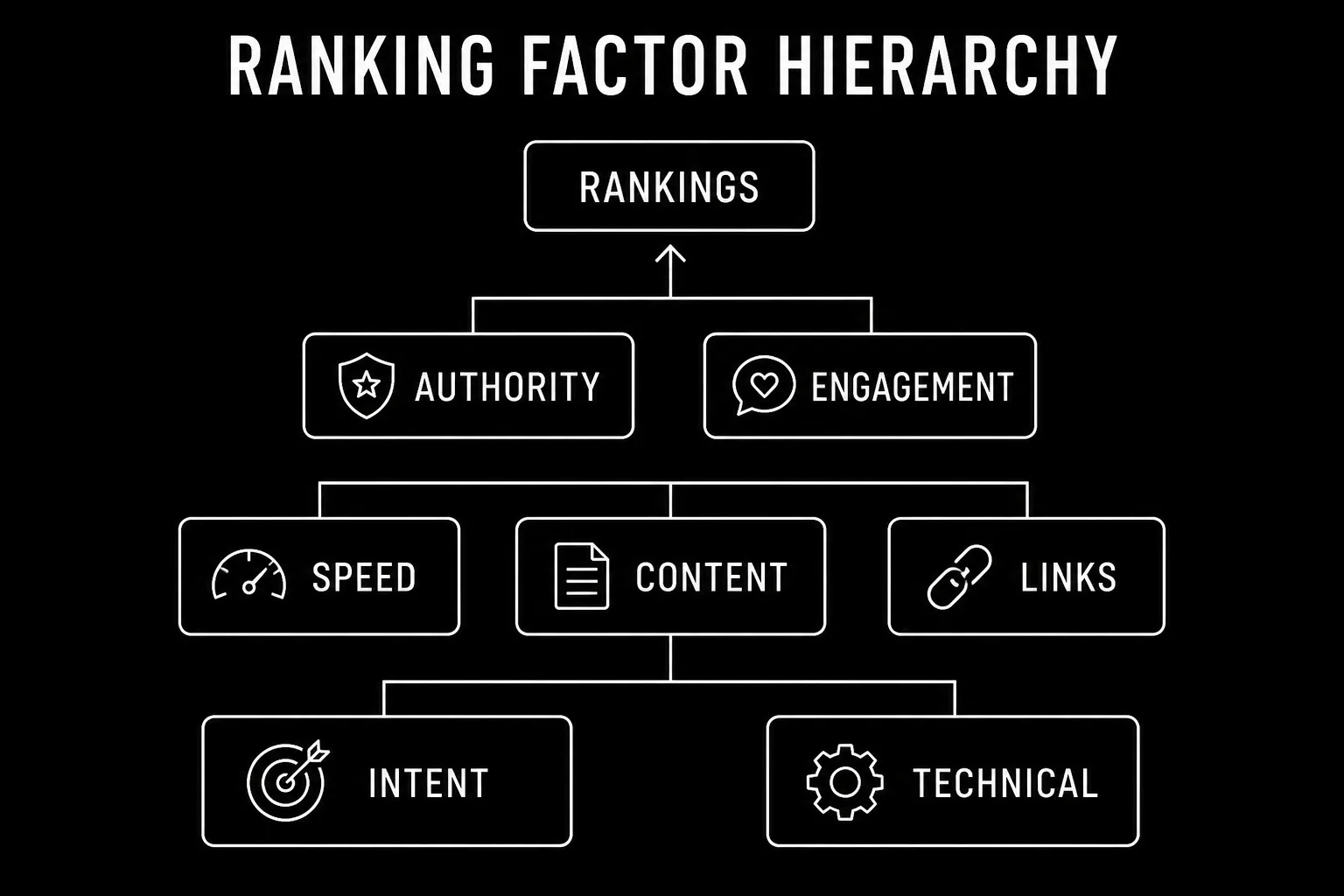
These seven factors are not equally weighted for every query, and the right emphasis depends on where your site currently falls short. For a new site, technical crawlability and content depth are the first priorities. For an established site with good content, authority and engagement signals are usually the next lever. Work through them in order and the rankings follow.
Frequently asked questions
The factors with the most practical impact are: relevance of the page to the search query, page experience and Core Web Vitals, the quality and authority of links pointing to the page, the depth and accuracy of the content, technical crawlability and indexing, user engagement signals, and for local searches, Google Business Profile signals. These seven account for the majority of ranking movement in most accounts.
Technical fixes can improve rankings within weeks. Content improvements take one to three months to be fully processed. Authority building through links takes three to six months to show consistent movement. The timeline depends on how competitive the keyword is and what condition the site starts in.
Yes. Core Web Vitals — Largest Contentful Paint, Interaction to Next Paint, and Cumulative Layout Shift — are confirmed ranking signals. A slow page ranks lower than a fast one with equivalent content, and it also converts less of the traffic it does receive.
Target keywords where the first page is reachable given your current domain authority. Build a page that directly and thoroughly answers the search intent. Fix technical issues that prevent indexing. Earn links from relevant sites. For local searches, optimize your Google Business Profile. There is no shortcut, but the path is well-defined.